Asset Allocation & Diversification: Key Concepts Explained
What is Asset Allocation & Diversification?
Asset allocation and diversification are essential for constructing a robust investment portfolio strategy.
Asset allocation in investment aims to balance the risk and return profile of a portfolio by distributing investments across various asset classes, such as equities, bonds and real estate, according to a client’s financial objectives, risk tolerance and investment horizon.
The goal is to mitigate the impact of market fluctuations within any single asset class. Different asset classes have distinct risk and return characteristics and respond differently to changes in market conditions, economic cycles and external events. When one asset class incurs losses, another may yield gains, thereby helping to stabilise overall portfolio performance and reduce volatility.
Diversification takes asset allocation a step further by spreading the investments within each asset class. By diversifying your investments across different asset classes, you ensure that you are not putting all your eggs in one basket and can better manage risk.
Strategic vs. Tactical Asset Allocation
The two primary approaches to managing a diversified portfolio are Strategic Asset Allocation (SAA) and Tactical Asset Allocation (TAA):
Strategic Asset Allocation (SAA)
SAA involves establishing target allocations (percentages of the portfolio) for various asset classes and regularly rebalancing the portfolio to maintain these targets regardless of market conditions. This is a long-term investment approach that emphasises stability over short-term gains.
Tactical Asset Allocation (TAA)
In contrast, tactical asset allocation (TAA) allows for dynamic short-term adjustments to the portfolio’s target asset mix based on market conditions, economic forecasts and valuations. By overweighting or underweighting asset classes relative to their strategic weights, TAA has the potential to outperform. However, making such adjustments is both challenging and introduces a level of active risk.
Both methods have their own merits and can be used depending on an investor’s preferences and investment fund strategy. SAA provides stability and a disciplined investment approach, while TAA offers the flexibility to respond to market changes.

The Role of the 60/40 Strategy
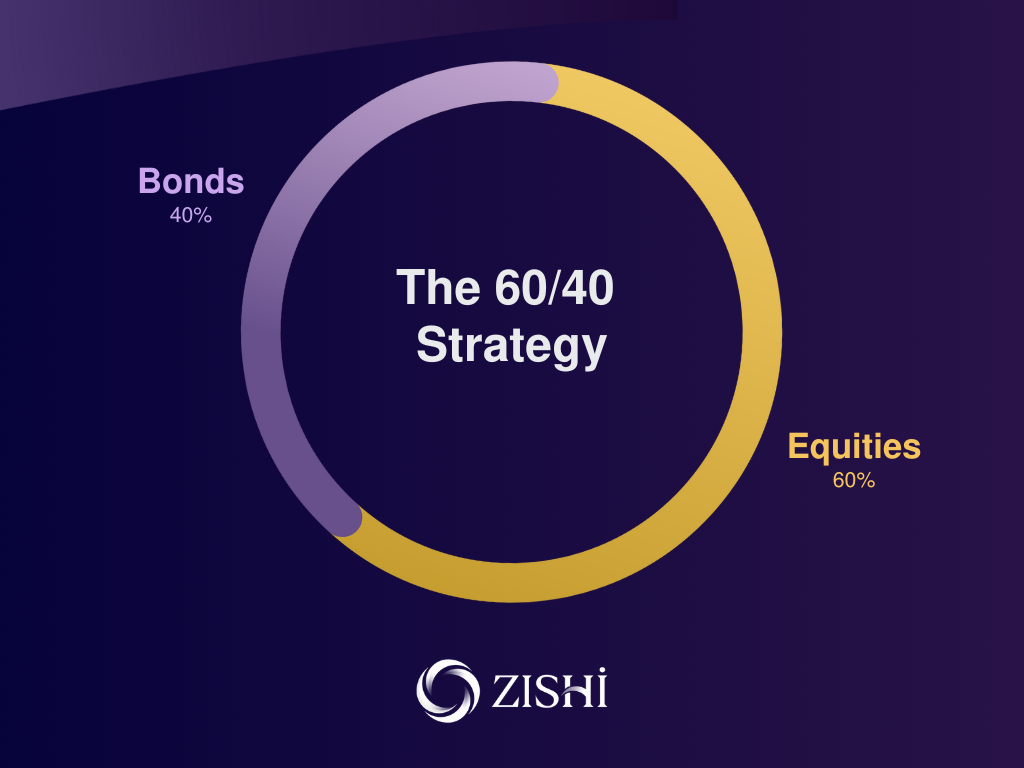
An example of a traditional asset allocation is the 60/40 strategy. The 60/40 strategy involves dividing a portfolio into 60% equities and 40% bonds. The purpose of the 60/40 split is to lower overall portfolio risk as the asset classes are uncorrelated to each other. Equities typically outperform during periods of economic growth, while bonds provide stability when markets are declining.
What Are the Benefits of Diversification?
For diversification to be effective, it is essential to include assets that exhibit low or negative correlation with one another. It can be implemented by investing in a variety of different securities, sectors, industries and geographic regions.
- Security diversification entails spreading investments across different securities within an asset class to reduce the influence of any single security’s performance on the overall portfolio.
- Sector and industry diversification spreads investments across multiple sectors and industries to minimise concentration risk.
- Regional diversification aims to mitigate the risks associated with investing in a single country or region by exposing the portfolio to various economic environments, political climates and market conditions.
Note that both asset allocation and diversification are intrinsically linked, since effective allocation inherently involves diversification.
The benefits of diversification go far beyond just reducing risk. A well-diversified portfolio tends to be more stable, particularly during volatile market conditions. Balancing the highs and lows of individual investments creates a smoother portfolio performance over time. It is important to note, however, that diversification does not mean compromising returns. Instead, it can enhance long-term growth by allowing the portfolio to take advantage of gains in various market segments while protecting against losses elsewhere. The key is to achieve an optimal balance, ensuring that the portfolio diversification strategy aligns with the investor’s risk tolerance, financial goals and investment horizon.
Conclusion
In summary, asset allocation and diversification work together to create a balanced and resilient investment approach. Asset allocation involves spreading investments among different asset classes, while diversification involves spreading investments within each asset class to reduce risk further. Both strategies are crucial for risk management in investing and optimising portfolio returns. Though a final word of caution; these strategies do not ensure a profit, neither guarantee against loss nor do they eliminate investment risk entirely. They provide a disciplined framework for investors to stay focused and maintain a steady course while navigating through volatile markets.
Author: Russell Hammerson, Principal Trainer | Finance Professionals Training & Development, ZISHI
Take Your Knowledge Further with ZISHI’s Asset Allocation Course
Understanding asset allocation and diversification is just the beginning. To help your organisation apply these principles in practice, take a look at ZISHI’s Asset Allocation Course – a corporate training programme designed specifically for investment teams.
This expert-led course guides professionals through the complexities of asset class selection, diversification and risk management to optimise portfolios across a range of client objectives.
Get in touch to discuss how we can tailor this training for your investment team.
FAQs
What is asset allocation?
Asset allocation involves distributing investments across various broad asset classes (like equities, bonds and real estate) to balance a portfolio’s overall risk and return profile. The right asset allocation usually depends on an investor’s financial goals, risk tolerance and time horizon.
What is diversification?
Diversification is the practice of spreading investments within and across asset classes. For example, investing in multiple sectors, securities or geographic regions of stocks. The goal of diversification is to reduce risk and increase the chances of achieving more stable returns over time.
How does diversification reduce risk?
Diversification reduces risk by including assets that have a low or negative correlation with one another. When one asset class or sector underperforms due to specific market conditions, another may perform well, thus helping to stabilise overall portfolio performance and reduce portfolio volatility.
What is the difference between asset allocation and diversification?
The difference between asset allocation and diversification lies in where and how risk is managed within a portfolio. Asset allocation is the process of deciding how much of your investment portfolio should be allocated to different asset classes. It focuses on the broad mix of assets. Diversification, on the other hand, spreads investments within each asset class to further reduce risk. For example, in equities, diversification means holding shares across different companies, sectors and regions rather than relying on a single stock.
What is the 60/40 investment strategy?
The 60/40 investment strategy is a traditional asset allocation model that divides a portfolio into 60% stocks and 40% bonds. The purpose is to balance higher-return but riskier assets with safer, income-generating assets. Although widely used, its effectiveness can vary depending on interest rates, inflation and economic conditions.
What is the best asset allocation for investment?
There is no single best asset allocation, as it depends on an array of individual circumstances and external factors. The optimal asset allocation is one that matches the investor’s goals, risk tolerance and investment horizon.
You might also be interested in:
See all courses