
Powering the Next Wave of Retail Trading Through Education
The Rise of Retail Trading
Retail participation in trading has accelerated in recent years. Digital platforms, the rise of mobile investing and the social visibility of markets have brought a new generation of traders into futures, derivatives and complex products.
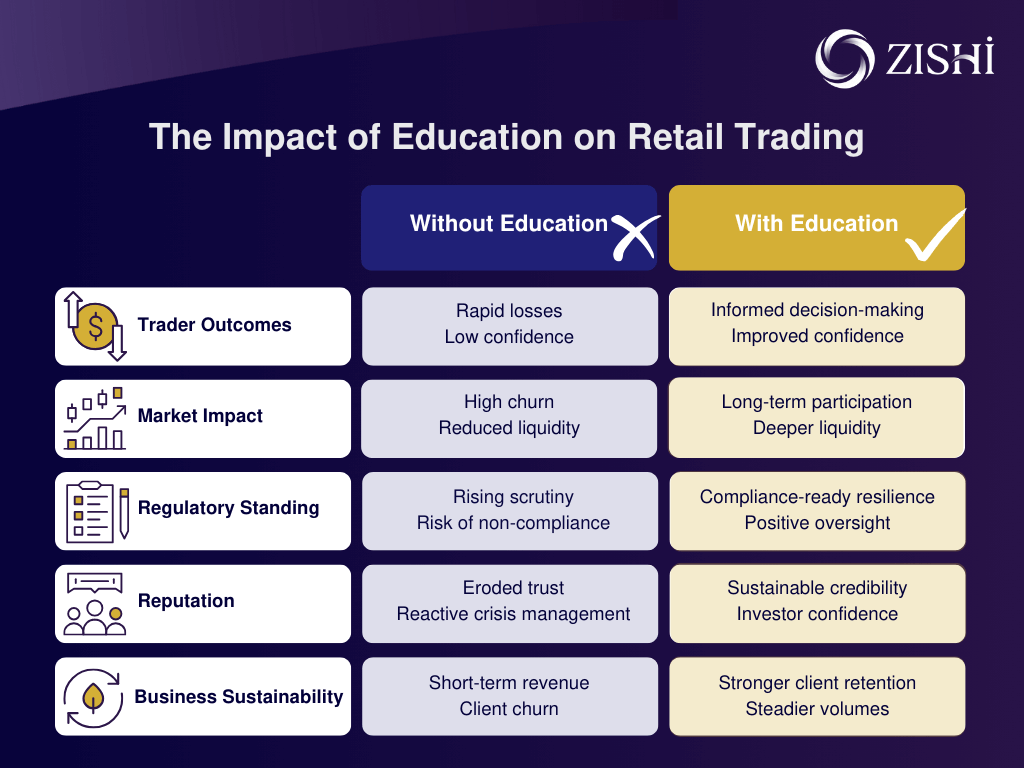
But this growth comes with a fundamental weakness: many retail traders lack a working understanding of leverage, margin or risk management. Without education, the pattern is predictable – rapid losses, high churn and mounting regulatory pressure.
It is widely acknowledged that most retail traders lose money – estimates suggest between 70% and 90%. Indeed, eToro reports that 76% of its retail accounts trading CFDs are loss-making. Together, these figures underline the scale of the challenge facing exchanges, brokers and regulators: without effective intervention, most new traders are set up to fail.
Why Education Matters to the Market
Exchanges sit at the centre of this challenge. Their reputations and the credibility of the wider market depend on how well retail participants succeed. When traders lose quickly, it undermines confidence, attracts regulatory scrutiny and risks slowing the very growth exchanges want to encourage.
The opportunity extends to exchange members too. Brokers and intermediaries build their businesses on retail flow, yet they suffer when clients churn. Short-lived trading accounts create instability and weaken liquidity. Members benefit most when traders develop skills that keep them active for the long term. Sustainable participation means deeper client relationships, steadier revenue and a healthier trading ecosystem.
It is well established that acquiring a new trader is up to 25 times more expensive than retaining one. Investing in education is not only cheaper than client acquisition but also far more effective. Forbes and others continue to highlight that even small lifts in retention can deliver disproportionately large profit gains – proof that building resilience through education is commercially sound as well as strategically necessary.
Embedding Education as Market Infrastructure
To build sustainable retail markets, education must be treated as infrastructure, not an afterthought. The most effective models are those embedded directly into trading ecosystems – adaptive, bite-sized and delivered at the point of need. Gamified modules and microlearning pathways allow traders to absorb complex concepts such as leverage or margin in a way that is accessible and measurable.
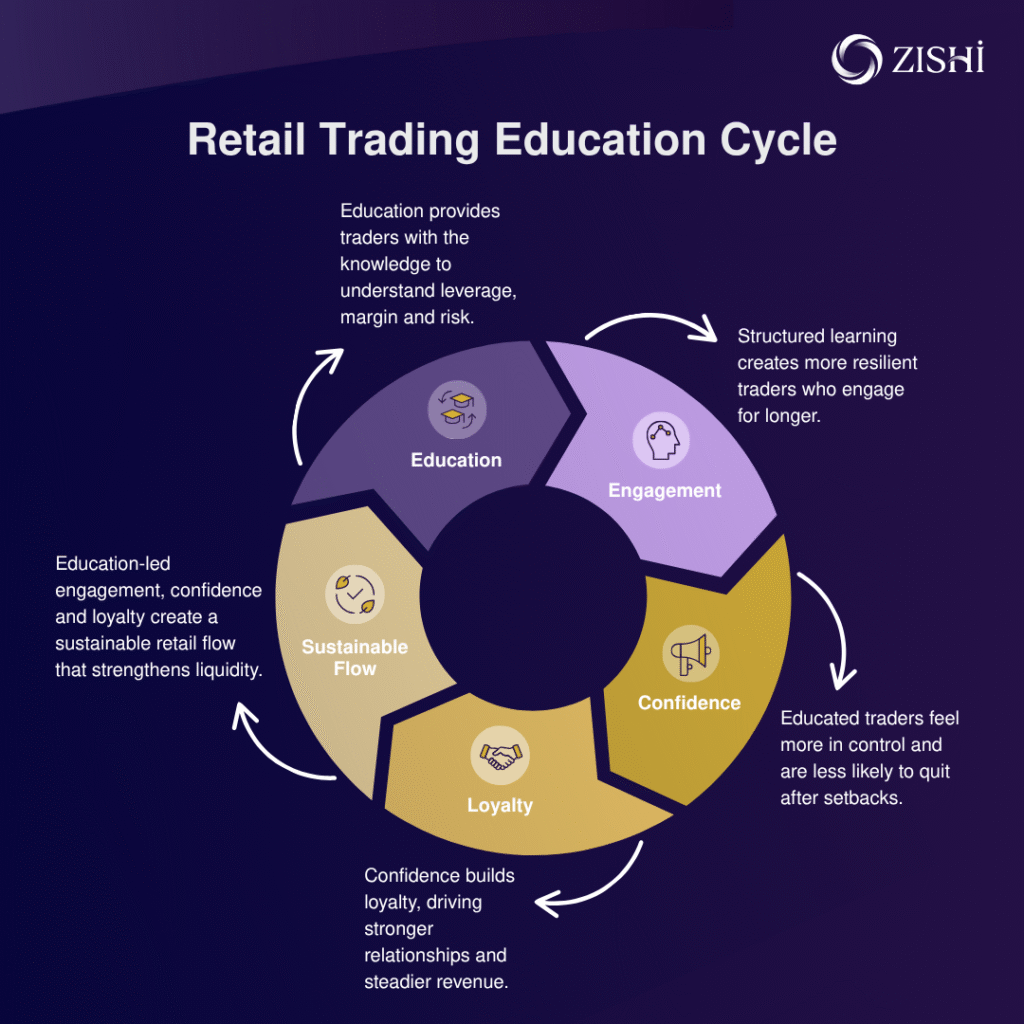
The evidence is clear: platforms that fail to provide education see higher churn and lower client confidence. In contrast, platforms that embed structured learning create more resilient traders who engage for longer and with greater confidence.
“Our work with professional traders shows that structured education transforms behaviour and outcomes. Bringing that same rigour into retail markets is how exchanges and their members can build resilience and meet regulatory expectations.” – Robert Russell, ZISHI’s Global Head of Professional Trader Qualifications
At ZISHI, we see that structured education supports lasting engagement – traders who complete programmes are more resilient, more confident and more likely to sustain their trading journey.
This aligns with wider industry findings: research consistently links higher financial literacy to improved investment decisions and longer market participation. Regulators such as EFAMA and ESMA also emphasise investor education as a cornerstone of market resilience. Given that ESMA reports 74–89% of retail CFD traders lose money, the case for embedding education is indisputable.
Crucially, this approach also satisfies the demands of regulators. Education delivered in a structured, compliance-friendly format demonstrates that exchanges and members are taking responsibility for retail outcomes. It shifts the narrative from reactive oversight to proactive leadership.
How Exchange Members Benefit from Retail Trading Education
The benefits of education extend beyond individual traders. The Retail Trading Education Cycle framework below illustrates how learning drives trader engagement, confidence and loyalty — resulting in a sustainable retail flow that underpins long-term member success.
Building a Sustainable Future
For exchanges, embedding education demonstrates leadership. It signals to regulators and participants alike that they take responsibility for protecting investors and raising standards.
For members, it creates a commercial edge by offering clients more than access – the tools to become resilient traders.
For retail participants, it turns speculation into learning and builds the confidence needed to sustain their trading journey.
Education isn’t optional; it’s the foundation of sustainable market growth. Those exchanges and members who embed education will set the pace for the industry, shaping markets that are credible, resilient and inclusive. The next wave of growth will not be measured in accounts opened but in traders retained – and education is the lever that makes this possible.
FAQs
Why is retail trader education important?
Most retail traders enter markets without understanding leverage or risk, leading to rapid losses and high churn. Education improves outcomes and protects the credibility of retail markets.
How can exchanges benefit from embedding education?
Exchanges reduce reputational risk, demonstrate regulatory leadership and support sustainable growth when retail participation is informed and resilient.
What role do exchange members play in retail education?
Brokers and intermediaries benefit directly when traders last longer — creating loyal clients, steadier volumes and stronger liquidity.
How does ZISHI support exchanges and members?
ZISHI provides scalable, white-label and API-integrated education through microlearning, gamification and compliance-ready content trusted by global institutions.
